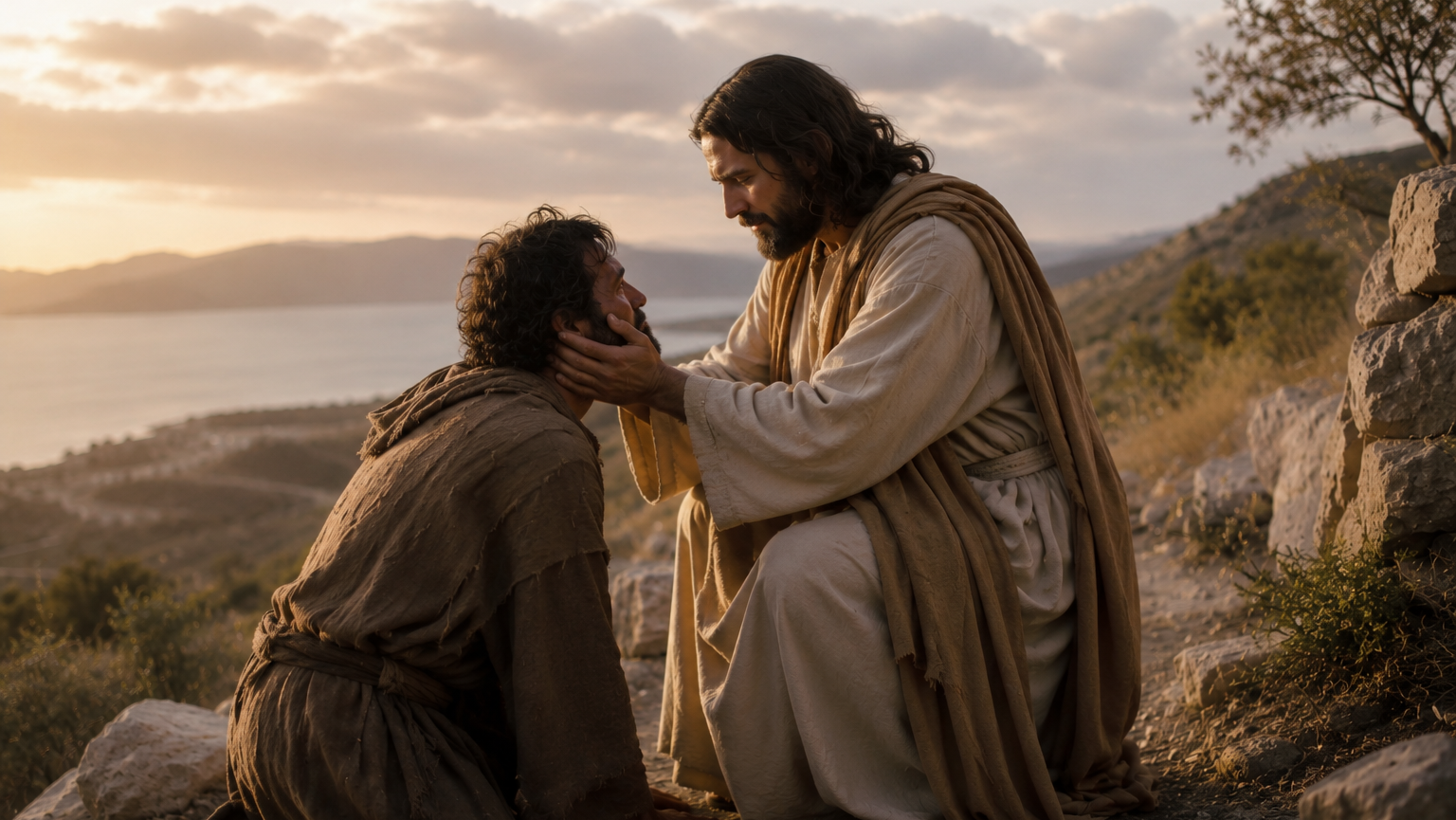
In his teaching series titled “The Mercy of God”, James Ryle shared the following story.
After the conclusion of World War II an International Military Tribunal held a set of trials for German officials involved in the war and the Holocaust during the Nazi regime. The trials were known as the Nuremberg Trails and were held from 1945-1949 in Nuremberg, Germany. Though 24 Nazi leaders stood accused, only 21 of them actually attended the trials. These men were accused of the murder of approximately 30 million people including 6 million Jews.
Before the trials began the defendants were offered attorneys and chaplains by the courts. Of the 21 offered, 6 asked for a Catholic priest and 15 asked for a Lutheran minister. When searching for a Lutheran minister the courts found a Lutheran U.S. Army Chaplain. This chaplain had lost two sons during the war and though he first refused to counsel these men, he later agreed.
Among the 15 men who asked for the Lutheran Chaplain were Goring, Sauckel, von Ribbentrop, Keitel and Rudolph Hess. The chaplain later told that as he stood before these men all he could say to them was, “Jesus Christ died for your sins and offers you forgiveness if you will accept it.”
During their very first meeting Sauckel feel to his knees and said, “Oh God, have mercy on me a sinner.” After a period of time reading the scriptures von Ribbentrop also sought forgiveness and received Christ. Keitel was another of the 13 men who sought God and received his mercy. Two of the men, Goring and Hess, refused God’s mercy and both later committed suicide.
As you read this story you might conclude that God’s mercy is not fair. How could God forgive these men of such heinous crimes? Well, you are right. God’s mercy is not fair. Why? Because mercy is something that none of us deserve. We all deserve the eternal punishment of hell, but God, through his Son has chosen to extend mercy to all who will trust in him.
Mercy is not only something God gives it is who God is; it is his character, part of his glory. Look at what God responded to Moses after Moses requested to see his glory. The Lord, the Lord God, merciful and gracious, longsuffering, and abounding in goodness and truth, keeping mercy for thousands, forgiving iniquity and transgression and sin, by no means clearing the guilty, visiting the iniquity of the fathers upon the children and the children’s children to the third and the fourth generation. (Exodus 34:6-7 NKJV)
King David wrote, I will praise you, O Lord my God, with all my heart, and I will glorify your name forevermore. For great is your mercy toward me, and you have delivered my soul from the depths of Sheol. (Psalm 86:12-13 NKJV) James Ryle commented, “Those who have been saved from the lowest hell enter into the highest praise.” Though each of us have come from different backgrounds and have experienced different “degrees” of sin, we were all headed in the same direction; hell. Our only hope was that God would show us mercy through the atoning sacrifice of Jesus Christ.
David also wrote, The Lord is compassionate and merciful; slow to get angry and filled with unfailing love. He will not constantly accuse us, nor remain angry forever. He does not punish us for all our sins, he does not deal harshly with us as we deserve. For his unfailing love toward those who fear him is as great as the height of the heavens above the earth. He has removed our sins from us as the east is from the west. The Lord is like a father to his children, tender and compassionate to those who fear him. For he understands how weak we are; he remembers that we are only dust. (Psalm 103:8-14 NLT)
Psalm 117 says, Praise the Lord, all you Gentiles! Laud him, all you peoples! For His merciful kindness is great toward us and the truth of the Lord endures forever. Praise the Lord! (NKJV) The Hebrew word used for praise in this passage is halal. According to Strong’s Concordance, halal means to be clear (orig. of sound, but usually of color); to shine; hence, to make a show, to boast; and thus to be (clamorously) foolish; to rave; causatively, to celebrate; also to stultify. The Hebrew word shabach is translated laud. It means to address in a loud tone. These words describe how we should respond to the Lord because of his merciful kindness toward us and the fact that his truth (Heb: stability, certainty, trustworthiness) last forever.
There is nothing in the word halal that indicates a passive acknowledgement of God’s merciful kindness. If fact, quite the opposite is clear when you look at the definitions of the words which define halal.
What does it mean to be clamorously foolish or to rave? The word clamorously is an adjective form of the word clamor. Clamor means a loud outcry or shouting; hubbub. A hubbub is a confused babble of loud sounds and voices; an uproar. The word foolish means lacking good sense or judgment or silly. The word rave means to speak wildly, irrationally, or incoherently, to roar or rage, speak with wild enthusiasm.
these words could easily describe a Saturday afternoon collegiate football game or maybe a Sunday afternoon professional game. Some of the fans do foolish things at the games like going shirtless in freezing weather and painting their faces and bodies with the team colors. In Green Bay the fans wear blocks of cheese on their heads while the fans in Cleveland wear dog masks and the fans in Minnesota wear Viking helmets. These fans leave no doubt who they are rooting for and where their affections lie. To be honest, they put much of the church to shame when it comes to praise. What is even more, they pay good money to be clamorously foolish in praise of their team.
I am not suggesting that we (the church) should run around the sanctuary or our neighborhoods with our shirts off, paint our bodies or wear silly outfits. I’m not saying that we should jump the pews, swing from the chandeliers or do something that would cause harm to ourselves or someone else. But, if these football fans can be that radical in praise of their favorite team, why can’t the church be just as radical in their praise of God? Would we be willing to pay $300, $200 even $100 for a stadium seat to radically praise God? Are we willing to look foolish to make it clear to the world that we are praising the God of our affections? Have we really understood God’s merciful kindness toward us?
Jeremiah, the weeping prophet, wrote, Yet I still dare to hope when I remember this: The unfailing love of the Lord never ends! his mercies never cease. Great is his faithfulness; his mercies begin afresh each day. (Lamentations 3:21-23 NLT) God owes us nothing, yet he freely gives what we do not deserve and could never earn. It is not by our works of righteousness, but according to his mercy he has saved us (Titus 3:5). And this mercy awaits us each morning. That deserves our loudest praise.